
If you are a high school student getting ready to apply to art and design programs, or a parent helping one, the art school portfolio is the part of the application to plan around. At many schools it carries the most weight, and reviewers read it as a window into how a young artist looks at the world and solves problems.
This post covers what reviewers look for, the requirements schools commonly set, what belongs in a portfolio, how to choose and order the work, and how to photograph it so it looks its best on a screen. It is written for juniors and seniors, and younger students can use it as a map for the years ahead. Each section stands on its own, so you can start with the part you need most.
What Art Schools Look for in a Portfolio
Admissions reviewers look for three things. The first is skill, and above all drawing from direct observation. A reviewer can tell within seconds whether a student has looked hard at a chair, a hand or a face, and that kind of looking is the base of every art major.
The second is original ideas and a personal point of view. Two students can draw the same still life and make two different pictures. The choices in cropping, mark making, subject and mood show who made the work, and reviewers enjoy seeing a person behind the pencil.
The third is potential over polish. A reviewer reading a stack of portfolios is judging how a student thinks and how far that student could grow in four years. A finished professional body of work is not expected from a seventeen-year-old. This is one of the most helpful college art admission tips to hold onto while you work: a drawing with honest observation and a few visible struggles tells a reviewer more than a slick piece copied from a screen.
Reviewers also take into account how much instruction and what materials a student has had access to. A student who has worked with a school art room and a pencil set is read in that light. Students starting from zero can read how that works in our guide to going to art school with no experience.
Common Art School Portfolio Requirements
Art school portfolio requirements differ by school and by major, so the first step is reading each school's own portfolio page, line by line. The patterns are consistent, though. Most schools ask for a set number of pieces, a minimum number of observational drawings, and recent work. Many take submissions through SlideRoom, often linked from the Common App. Early deadlines come in the fall. Some ask for written descriptions or an artist statement, many have rules on AI-generated work, and some majors make the portfolio optional.
Three Michigan schools show how far the requirements can spread.
| School | What the portfolio asks for | Other details |
|---|---|---|
| College for Creative Studies, Detroit | 5 to 12 strongest works, with at least five drawings from direct observation and/or imagination | Some majors are portfolio optional; AI-assisted work is capped |
| University of Michigan Stamps School of Art & Design | A portfolio submitted through SlideRoom | The portfolio makes up half of the admissions decision |
| Kendall College of Art and Design, Grand Rapids | 8 to 10 pieces of best, most recent work, 2D or 3D | BFA in Studio Arts; a 2.50 high school GPA is also asked for |
At College for Creative Studies, majors that require a portfolio ask for 5 to 12 of the applicant's strongest works, and work from the last two years is often the strongest. The pieces do not need to relate to the intended major. Some majors are portfolio optional, and first-year applicants to those majors with a GPA of 3.0 or higher can be admitted on GPA alone. The same guidelines allow AI tools for process and research only, with prompts cited and no more than one AI-assisted piece in a portfolio.
At the University of Michigan Stamps School, 50% of the admissions decision rests on the portfolio. It goes through SlideRoom from a link in the Common Application, with a $10 fee that is waived for students with a Common App fee waiver. Deadlines are November 1 for Early Action and Early Decision and February 1 for Regular.
At Kendall College of Art and Design, the BFA in Studio Arts asks for 8 to 10 pieces of the applicant's best, most recent work, in 2D or 3D.
What to Include in an Art Portfolio
Knowing what to include in an art portfolio makes the planning simpler. Four ingredients show up again and again.
Drawings From Direct Observation
Still life, the figure, interiors and landscape all work. Draw what sits in front of you, in the room, with real light falling on it. Drawing from life trains the eye to judge proportion, edges and value, and reviewers can see that training on the page. A photograph flattens those decisions, so work done from life reads as more convincing.
Range of Media and Subject Matter
Show comfort with more than one material and more than one kind of subject. Graphite, charcoal, ink and paint each carry a different kind of control, and a mix of portrait, interior and object studies shows a student who can adapt. A portfolio does not need every medium. Two or three used well make the case.
A Few Strong Sketchbook Pages
Sketchbook pages show process and ideas. A reviewer sees how a thought moved from a rough note to a worked drawing. Choose these pages as carefully as the finished work, picking the ones where the thinking is clear and the drawing is lively.
A Short Series or Investigation
A group of related works shows sustained thinking on one idea. It could be five drawings of one corner of a kitchen at different times of day, or a set of studies built around one object. AP Art and Design uses the same idea: its Sustained Investigation asks for 15 images that can include process and detail shots. A series like this gives a reviewer a reason to keep looking.
What to Leave Out
Leave out fan art, copies of other artists' work, copies of photographs, and anything the student cannot stand behind. A good test is whether you could talk about the piece for two minutes, from the first mark to the last decision.
How to Curate Your Artwork
Curating artwork starts with making more work than the portfolio needs. If a school asks for twelve pieces, make twenty or thirty and edit down. A bigger pool gives you real choices, and each choice sharpens your eye.
One weak piece lowers the whole set, because a reviewer remembers the dip. Cut the piece that makes you wince, even if it took the longest.
Choose the opening and closing pieces with care. The first image sets the tone and the last one stays in the reviewer's mind, so both should be among your strongest and most personal works.
Order the middle so the set reads as a whole. Group related pieces, vary scale and subject so the eye keeps moving, and let a thread run through the work. Then look for duplicates. Two pieces that show the same skill in the same way say the same thing twice, and the stronger one earns the slot.
Outside eyes help, because the maker is the last person to see the work fresh. Teachers and studio instructors can tell you which pieces carry the set. Admissions reviewers at portfolio review events can tell you how the work reads to the people who will judge it. Stamps also offers 15-minute virtual meetings for informal portfolio feedback. Ask each person which three pieces they would keep and which one they would drop, and look for the answers that repeat.
How to Photograph Artwork for Your Portfolio
Reviewers see a photograph of the work, so documentation counts. Learning how to photograph artwork takes an afternoon and pays off across every application.
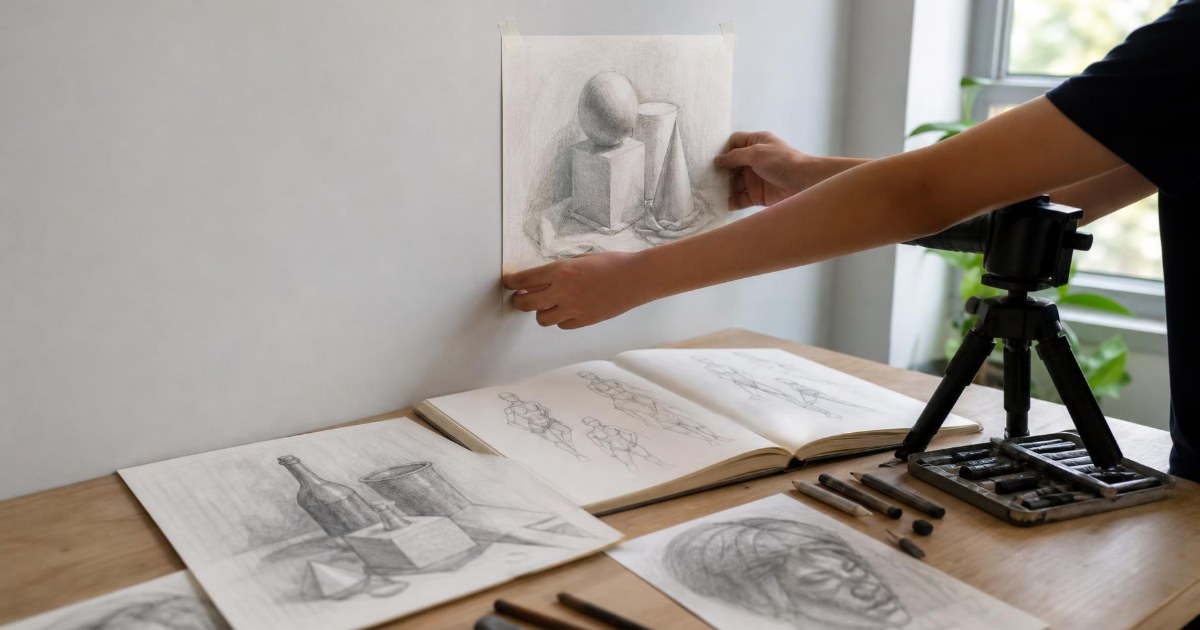
For 2D work, hang the piece flat against a neutral wall. Square up the camera so the lens sits level with the center of the piece, which keeps the edges from leaning. Light it evenly from both sides. A common setup places two lights, with daylight bulbs preferred, halfway between the camera and the wall at a 45-degree angle to cut glare. On a DSLR, an ISO around 100 and an aperture of f/8 to f/11 keep the image sharp, and a timer of four to five seconds avoids shake. Skip the flash and direct sun. Take work out of glass where possible, since glass throws reflections. Then crop out the wall and floor so only the piece shows. College for Creative Studies asks for well-lit photos taken directly from the front, not at an angle, which matches this approach.
For 3D work, use a neutral seamless backdrop, such as paper curved down from the wall so there is no hard line behind the piece. Shoot more than one view. AP 3-D Art and Design, for example, asks for two views of each work. Add a detail shot wherever texture or craft matters, such as a carved edge or a glaze surface.
Finish by labeling every image with the title, medium, dimensions and year. Keep the labels in a file name or a simple document so they are ready when a submission form asks for them.
Art Portfolio Examples: What Strong Submissions Have in Common
Art portfolio examples published by schools and teachers tend to share four traits. The drawing is confident and rooted in observation. A recognizable voice runs through the work, so a reviewer could pick out the student's pieces in a lineup. A clear thread connects the pieces, whether a subject, a mood or a question. And the documentation is clean, with even light, square framing and sharp focus.
The best place to see these traits is the example galleries that schools publish on their own admissions pages. Those galleries show the level of work each school sees, and they come with notes on why a piece succeeded. Look at a few from each school on your list and ask the same questions of each. Where is the strongest observational drawing? What ties the set together? How does the photography present the work? Your answers become a checklist for your own selection.
Looking at examples is for learning how strong work behaves. Your own portfolio gets its power from your subjects, your hand and your decisions.
A Portfolio Timeline, From Junior Year to Submission
A portfolio takes months to build. Starting during junior year gives you time to make plenty of work, edit it and fix gaps.
Plan on feedback early. National Portfolio Day events are free for students, and the 2026-27 schedule includes a Michigan event on October 18 at Kendall College of Art and Design in Grand Rapids, plus online undergraduate events on November 7, December 5 and January 10. Attending in the fall of junior year and again in the fall of senior year lets you hear what reviewers say, make changes, and check the results.
Build a spreadsheet for the schools on your list. Give each school a row with its piece count, file format, written requirements and deadline. The sheet saves you from mixing up a 5-to-12 piece request with an 8-to-10 piece one.
Leave time to photograph the work and write descriptions before early deadlines, which at many schools fall around November 1. A good rhythm is to finish the making by late summer of senior year, spend September on editing and photography, and use October for statements and a final review.
Building Portfolio Skills at Atelier School of Art
Atelier School of Art in Royal Oak supports students building toward a portfolio. Teen Studio is a weekly class for teens, where students work in a variety of mediums with monthly themes that have included painting, drawing, printmaking, fiber, mosaics and sculpture. Students learn to show personal expression and style in their art, and all materials are included.
Teens can also take Atelier Drawing, which covers perspective, sight measuring, composition, block-ins and shading, and Art From Life, which covers drawing and painting from direct observation, gesture, proportion and anatomy. Both are listed among the ongoing classes open to teens and adults. The Teen Summer Art Camp welcomes ages 12 to 18, with no experience required.
One parent wrote in a review on the school's site that her daughter's portfolio earned excellent scholarship awards from her first-choice art school after two years of classes at Atelier.
To start building your own portfolio, you can Register for Classes or Tour the Studio and see the space where the work happens.